More from

More Modelling

Nine More Penrhyn Wagons

Penrhyn Lime Wagon

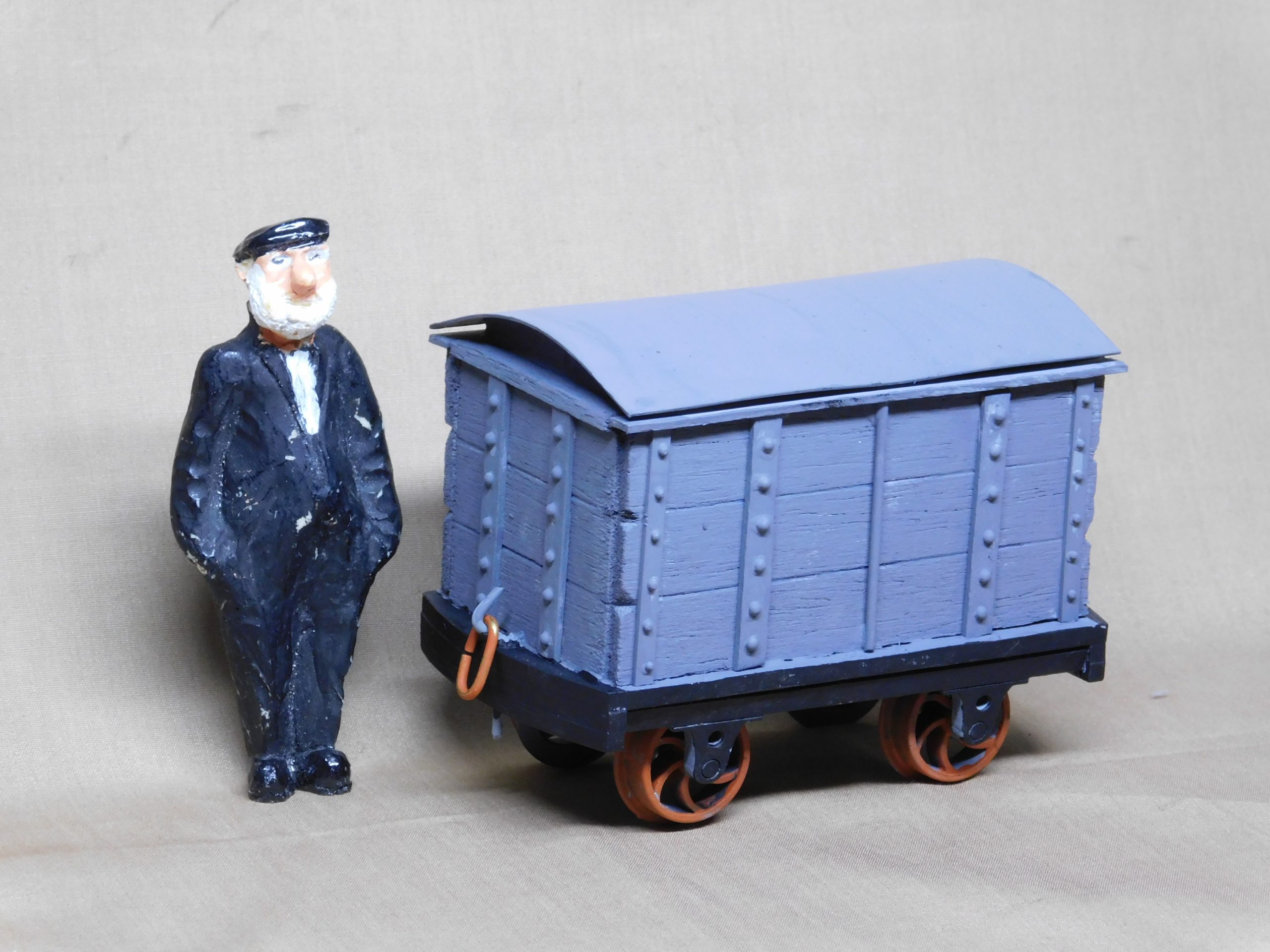
A photograph of Port Penrhyn, dating from about 1890, shows a unique wagon off-rails beside the weighbridge building. This wagon was similar to a Penrhyn 2-plank coal wagon but with the addition of a third plank and a curved metal roof. This roof was evidently removable to access the contents of the wagon which was originally believed to be coal for heating the weighbridge office. However, it is now understood that the wagon was used to transport lime from Port Penrhyn to the estate and to the quarry.

In the quarry, lime was used as an ingredient for mortar in buildings as well as the finish on some internal walls. The Penrhyn estate also used lime in agriculture for improving the soil. A roof was necessary on the wagon to prevent the lime from reacting with rainwater and becoming ‘slaked’. Rather than adapting one of my rake of Penrhyn 2-plank coal wagons, I opted to scratch build the bodywork onto one of my repurposed PS Models freelance quarry wagons. These have the correct wheelbase, frame dimensions and the prototpical curly-spoked wheels.

The lime wagon was built with reference to the drawings in a back issue of Y Llechen – the Penrhyn Railway & Quarry Journal. First, the body was constructed from balsa sheet and scribed to represent the three planks. External detail was added using wood offcuts, plasticard strip and brass wire. A curved roof was fabricated using plasticard sheet fixed to a wooden frame. Coach bolt detail was added using 1.5mm and 1.0 mm half-moon NailArt before painting the bodywork in the correct shade of Penrhyn grey with black for the frames.

Penrhyn lime wagon.
Penrhyn lime wagon.

Penrhyn Skip Wagons


Despite the size of the quarrying operations, Penrhyn only ever possessed one of the ubiquitous Hudson skip wagons, that was purchased in 1908 and spent much of its life rusting on an unused quarry level. However, there were four other steel bodied, side tipping skips in general use in the Coed-y-Parc yard. Two of these skips were built on wooden frames and two skips, presumably built at a later date, had a steel channel frame. The riveted tipping body of the skips was rectangular in plan with tapered sides and a flat base.


To model the single Penrhyn Hudson skip wagon, I turned to the excellent kit produced by Peter Binnie that I had previously used for a Tunstead quarry rake and as War Department Light Railway K class wagons. The plastic kit goes together easily and I retained the plastic wheels rather than substitute with metal wheelsets as the model, like the prototype, will not see too much action behind my quarry Hunslet. The livery of the Hudson skip wagon was assumed to be Penrhyn grey.

Penrhyn Hudson skip wagon.

For the other Penrhyn skip wagons. I turned to the excellent design and 3d print skills of Roy Plum, a fellow member of the Yorkshire 16mmNGM Group. Using a contemporary description and a number of black and white photographs, models of both the wooden frame and steel frame skips were printed. A slightly shallower skip body was noted in use with the wood frame prototypes and this difference was incorporated in the models.


Assembly of the steel frame model was greatly aided by a  simple jig that had been 3d printed. As designed, the model skip bodies have the ability to tip in either direction dependant on which retaining bars you choose to glue in the open or closed positions. Binnie curly-spoked wheels were used to match those on the Penrhyn slate trucks. Similarly, hook and ring couplings were used. Two examples of each type of skip were built to match the Penrhyn inventory.  All were painted in Penrhyn grey livery with black for the wooden frames.

Penrhyn wood framed skip wagons.
Penrhyn steel framed skip wagons.
Three types of Penrhyn skip wagon.

Penrhyn Foundry Wagons


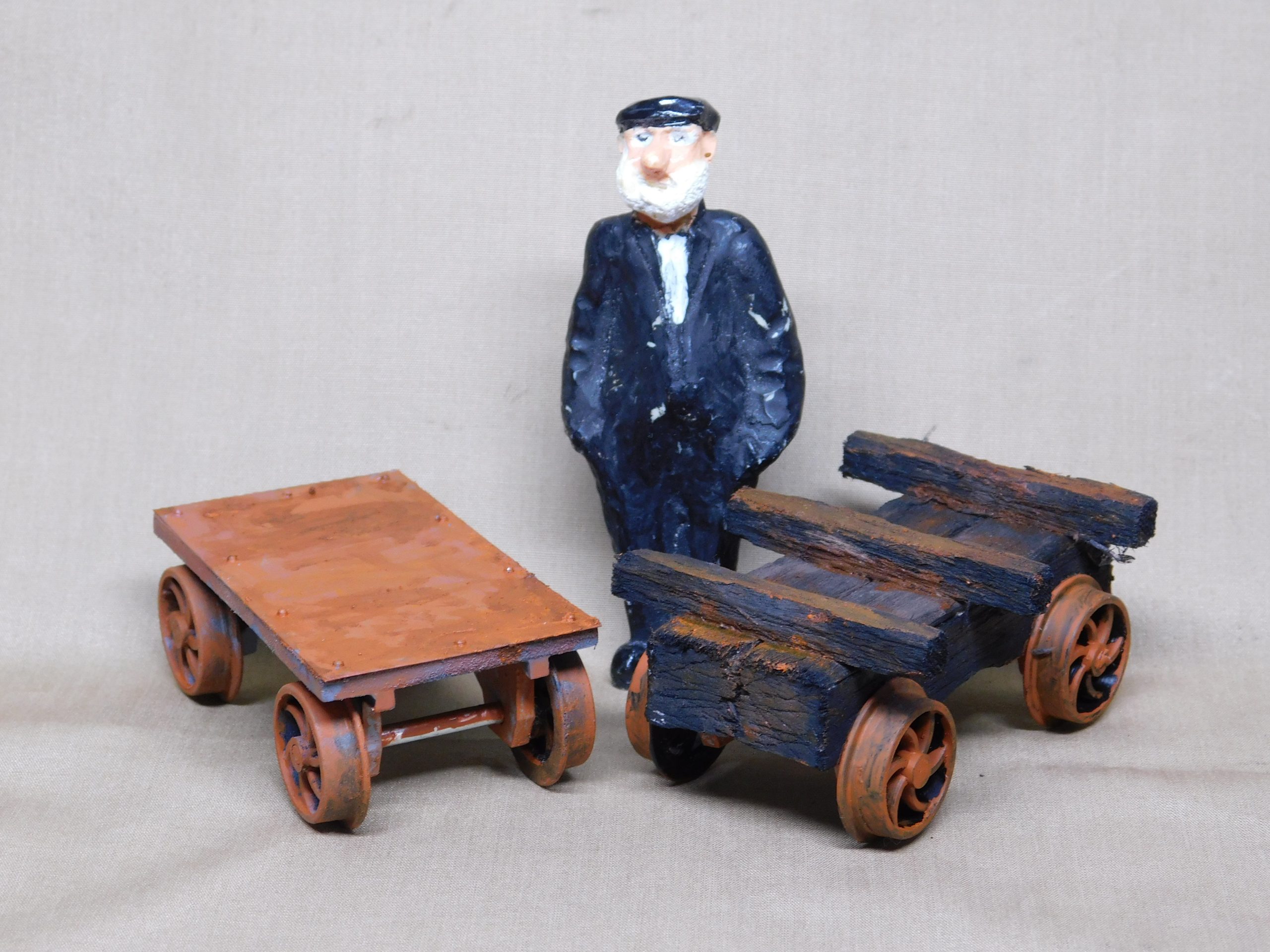
A recently compiled list of Penrhyn railway wagons includes a reference to two types of foundry wagon. A foundry was built at Felin Fawr at the quarry end of the railway sometime after 1830 but I have not been able to find further details, or photographs, of any foundry wagons. Other 19th century foundries often had small hand-worked rail wagons of two basic types – a crude wooden wagon to carry larger items and a small wood-framed flat wagon, sometimes covered with a metal sheet, designed to carry the smaller castings.


The starting point for both wagons was again a repurposed PS Models freelance quarry wagon with the contemporary Penrhyn curly-spoked wheels. Although the wheelbase was slightly too large for these two models, the wagons were proven to run well on 32mm track and so the wheelbase was retained. The rustic appearance of the first model was fabricated using wood offcuts on the basic wagon frame. The wagon has two longitudinal beams, that carry the inside axles, and three transverse wooden members to support the load, similar to the sleds for transporting slate blocks.


The second wagon has the wooden flatbed of the donor wagon cut down to the correct dimensions and covered with a metal sheet fabricated from plasticard. NailArt 1.5mm half-moons were used to represent the coach bolts that hold the metal sheet to the wooden flatbed underneath. This wagon was painted in Penrhyn grey, with black used for the all wood wagon. Both wagons would have acquired a liberal coating of rust and metal filings during their use in and around the Felin Fawr foundry.

Penrhyn foundry wagons.

Dixon’s Improved Slate Wagon


There is very little detailed information as to the design and construction of slate waste wagons in use at Penrhyn, or any other Welsh slate quarry, in the early 19th century. Edwin John Jeffrey Dixon was proprietor of Bryn Hafody Wern slate quarry in Bethesda who, in 1852, filed a patent for an improved slate wagon. Despite the name, the wagon was for the transport of waste rock rather than finished slates. Bryn Hafody Wern had been previously worked in the 18th century by the landowner, Richard Pennant, the 1st Baron Penrhyn.


Although no wagons of this patent design are recorded as working at Penrhyn quarry, it is worth noting that the wagon was intended to run on the round-section, 22¼ inch gauge rails in use at Penrhyn at that time. Furthermore, the removable sides of the improved slate wagon bore a strong resemblance to those adopted for the Penrhyn fullersite wagons. Dixon’s wagon is included here as a Penrhyn ‘might have been.’ This model was built with reference to plans first published by the Narrow Gauge Railway Society.


The wagon itself had no underframe with only two longitudinal wooden supports and no stretchers. Rigidity of the wagon relied on the sheet metal of the load bed with the removable sides of the bodywork contributing little additional stiffness. The bodywork of the model was fabricated from plasticard sheet and detail added using offcuts of wood and brass. Binnie curly-spoked wheels were used along with axle boxes from my bits box. Bolt head detail was added using half-moon NailArt. The bodywork was painted in Penrhyn grey livery, with black used for the wooden members.

Dixon's improved slate wagon.
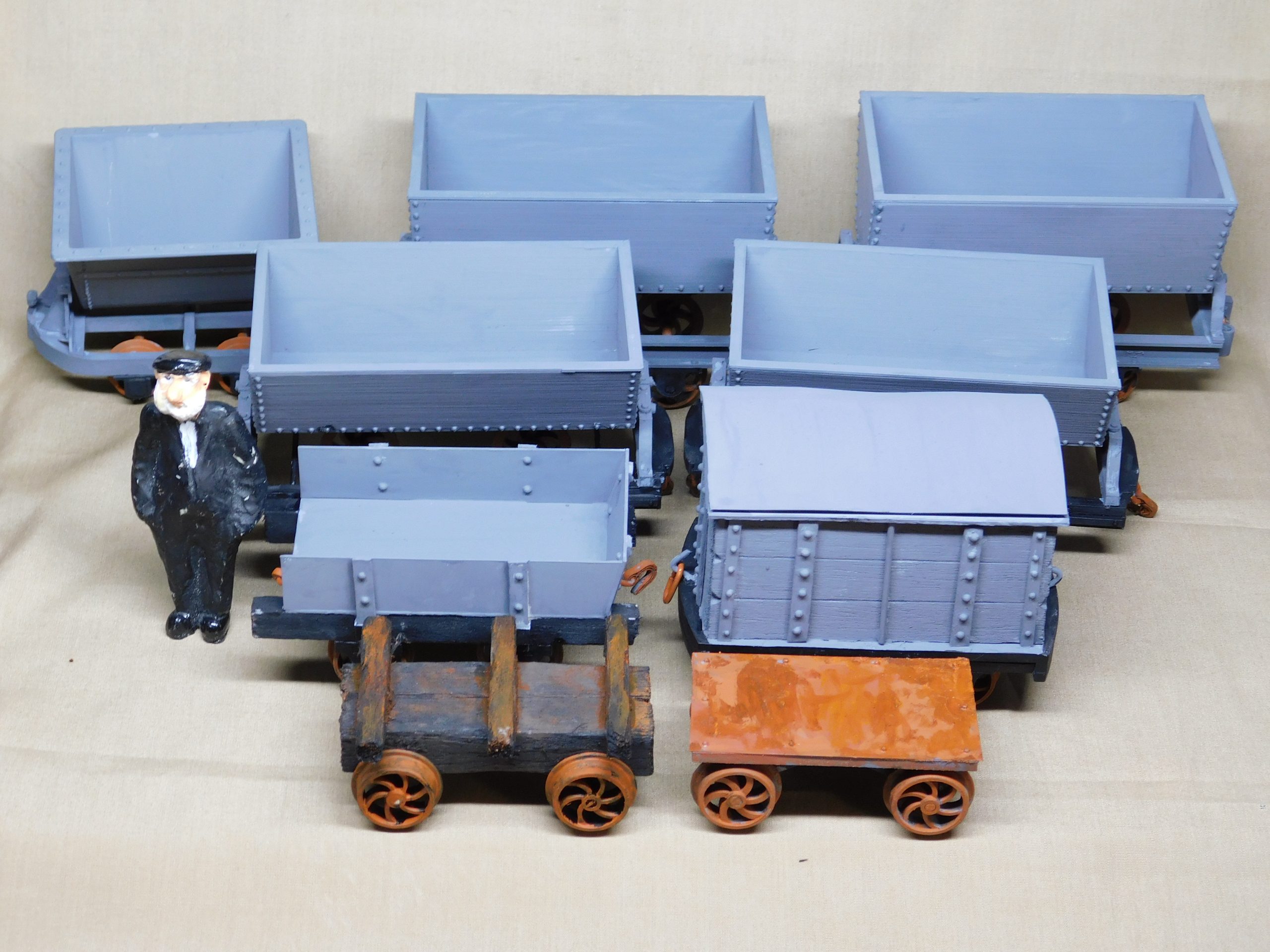
Nine more Penrhyn quarry wagons.

November 2024

Written by