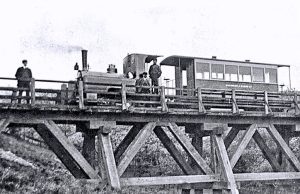
Alan writes, ” Here is something that I put together as part of a series about narrow gauge lines near to where I live. The Chew Tramway was in West Yorkshire at the time of operation.”
Prior to the formation of Greater Manchester in 1974, Greenfield and the Chew Valley were in the West Riding of Yorkshire. Situated on the route over Saddleworth Moor from Holmfirth, the area is on the western slope of the Pennines
In 1870, when the Ashton, Stalybridge & Dukinfield Waterworks Joint Committee started work on the reservoirs in the valley above Greenfield, they had to undertake to build a separate compensation reservoir to maintain water levels for the mills along the River Tame. Starting in 1907, Chew Reservoir was built on high moorland in what is now Greater Manchester. At 1,600 ft above sea level, the reservoir was the highest in England when it was completed.
Stone for masonry and aggregate, needed to build the dam wall, was obtained from an adjacent quarry. However, other construction materials, including large amounts of puddle clay to waterproof the dam, had to be brought to the site. A 3 ft gauge tramway was built between the puddle fields, and the adjacent LNWR exchange sidings, almost four miles away to the base of an incline that lifted the materials to the level of the reservoir high on the moor. The tramway, with a ruling gradient of 1 in 30, was steam worked using six tank engines and the 1 in 4 incline was worked by a steam winch.
Stone retaining wall of the 3 foot gauge Chew Tramway.

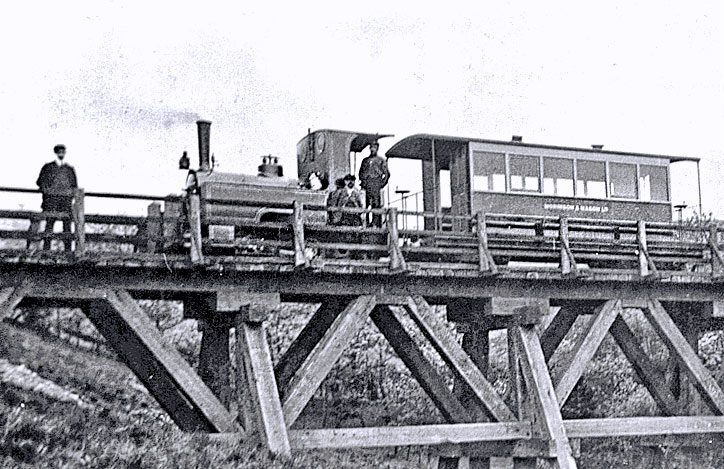
The contractors responsible for the construction were Morrison & Mason Ltd of Glasgow whose name adorned the sides of the bogie balcony carriage used for officials and visitors. Workmen had to make do with two tin-roofed, windowless coaches with back-to-back seating that acquired the nickname cattle wagons. Additional rolling stock included a large number of wooden MSC (Manchester Ship Canal) type side-tipping wagons with dumb buffers. The tramway was single track throughout with no passing places except for the sidings at either end.
There were six contractors locomotive on site; five built by Andrew Barclay and one of unknown origin. One of the Barclay locomotives, called Preston, was an 0-6-0 with works number 1188 of 1907. The remainder of the locomotives were 0-4-0s and included Barclay works numbers 839 and 840 of 1899. The identity of the remaining locomotives is unclear, however, one of the five was called The Pig. Three of the locomotives were permanently positioned above the incline to move wagons the final ¾ mile to the construction site and to shunt materials from the adjacent quarry.
One of the Andrew Barclay locomotives standing on the trestle bridge. Photograph from a display board previously at this location.
In addition to the morning paddy mail carrying workmen, five trains a day were run over the tramway bringing puddle clay. The 0-4-0 locomotives could pull six loaded wagons and the 0-6-0 could haul six wagons plus a wagon of coal. Four other trains were run with four wagons carrying a variety of other materials from the exchange sidings, including cement, animal fodder and supplies for the workers in the barracks by the dam. The trains climbing laboriously through fields and onto the rough slopes above could be seen by local residents who used the terms: Chew Valley Express or Puffing Billy.
One locomotive was usually out of service for repairs or maintenance and a small engine shed for the purpose was provided. Water for the engines was originally taken from one of the streams flowing down the steep hillside. However, problems developed with the boilers through using this acidic, peaty water and a pipe was laid to bring a supply of clean water to the engine shed. Coal for the locomotives was obtained through the LNWR exchange sidings near Mossley, along with all of the other daily necessities of a major engineering contract.
A short 2 ft gauge, horse worked railway was also used between the sidings at the base of the tramway incline and a second incline that accessed a tunnel being dug for a water pipeline high on the opposite side of the valley. Rolling stock on this line was entirely steel side-tipping skips of one cubic yard capacity that were termed Jubilees. About half a mile before the tramway incline, another section of 2 ft gauge track connected to tunnelling work associated with the two reservoirs that had been built previously. This second track was also worked using horse-drawn side-tipping skips.
Despite a cement shortage in 1908, and a coal strike in 1912, Chew Reservoir was completed in December 1912. However, when the reservoir was filled, water leaked around the edges of the dam and further work was required to extend the waterproof core in both directions. By January 1914, the reservoir was full again and leak free. The tramway was subsequently dismantled and the Morrison & Mason locomotives were moved on to a number of other contracts by September of the same year.
Location of the trestle bridge, now with a footbridge.
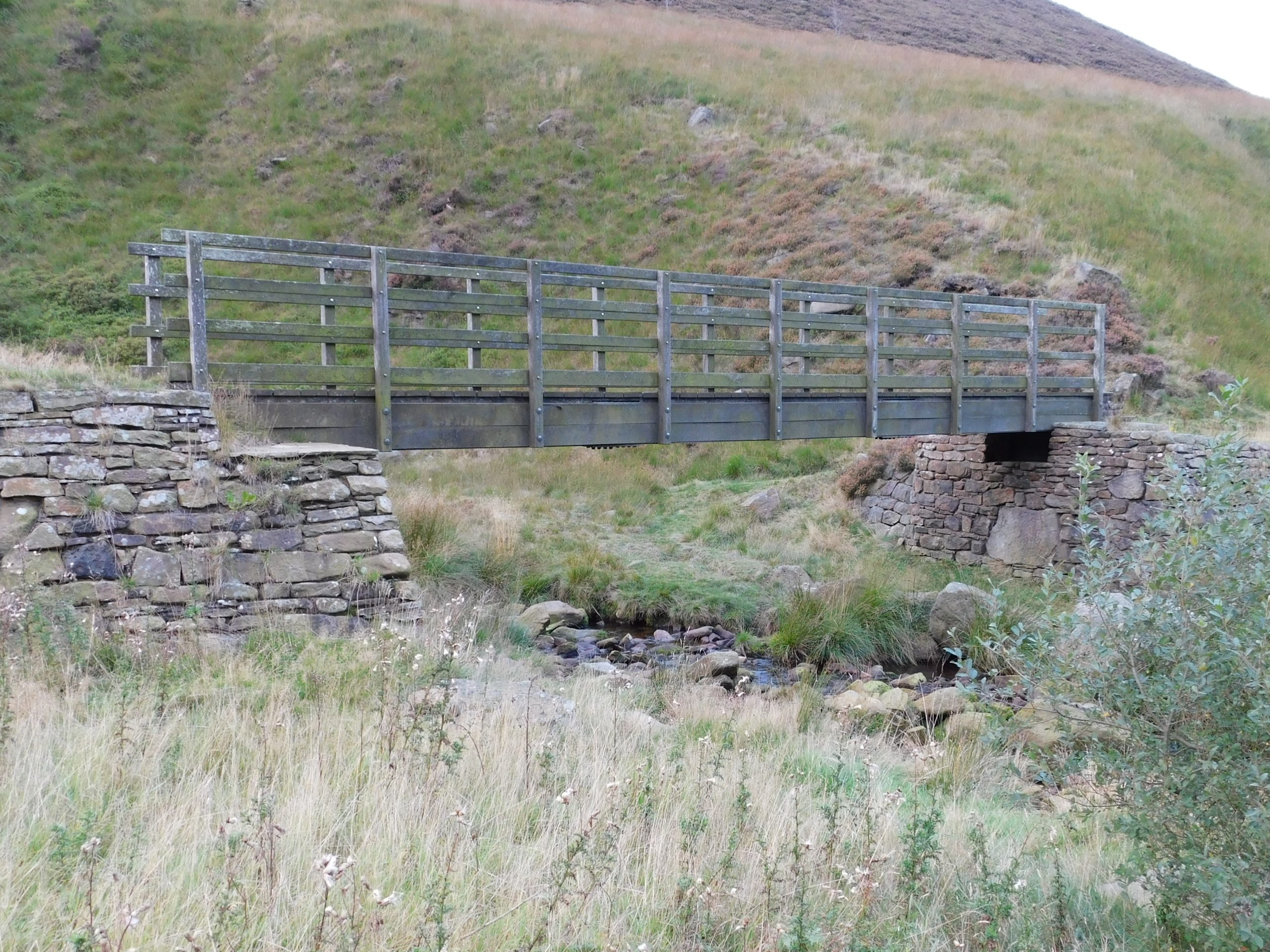
Nowadays, the puddle fields and exchange sidings are largely covered by houses but much of the tramway route can be walked as part of the Oldham Way. At the base of the tramway incline can still be found a substantial stone railway embankment and the abutments for the wooden trestle bridge. One Morrison & Mason locomotive, Barclay 840, was later sold and, by 1916, was owned by the British Aluminium Company in Scotland. During 40 years of service with that company, the locomotive became known as The Fair Maid of Foyers and is now preserved at the Bo’ness & Kinneil Railway